When Back Pain Stops Staying in Your Back
There’s a specific kind of fear that sets in the first time lower back pain travels somewhere new, shooting down your glute, into your thigh, or all the way to your foot. That radiating pain has a name: sciatica. It’s one of the most common reasons people search for answers about their back pain online, whether they’re looking for professional guidance or a back pain online course, and one of the most misunderstood.
What’s Actually Happening in Your Spine
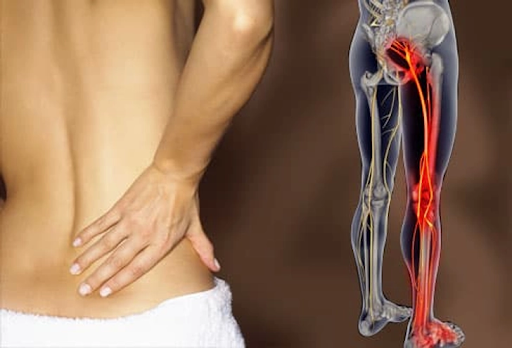
Sciatica isn’t a diagnosis in itself. It’s a symptom, caused by irritation or compression of the sciatic nerve, the longest nerve in your body, running from your lower back through your hips and down each leg. That compression usually comes from a herniated or bulging disc pressing on a nerve root, or from spinal stenosis, a narrowing of the space where the nerve exits the spine, similar to what we saw in an avid golfer client whose MRI showed both facet joint degeneration and stenosis alongside his radiating pain.
The pain, numbness, or tingling you feel in your leg isn’t a separate injury. It’s your nervous system reporting irritation happening back at the source, in your lumbar spine.
Why the Pain Feels So Unpredictable
Sciatica symptoms often seem to have a mind of their own, better one day and sharp the next, sometimes worse with sitting, sometimes worse with standing. That’s because the nerve’s sensitivity is influenced by inflammation, posture, and movement patterns all at once. Prolonged sitting, poor lifting mechanics, and even a hyperextended back extension exercise done incorrectly can all increase pressure on the exact structures irritating the nerve.
What Usually Helps, Before Considering Surgery
The overwhelming majority of sciatica cases improve with non-surgical care once the underlying mechanical stress is addressed. Surgery is occasionally necessary for progressive weakness or loss of bladder or bowel control, but for most people, a structured approach addressing movement, posture, and inflammation resolves the irritation at its source.
- Correcting the daily movement patterns, like sitting posture and lifting mechanics, that keep re-irritating the nerve
- Gentle decompression-focused movement, such as walking with intention, rather than aggressive stretching that can sometimes worsen nerve irritation
- Addressing internal inflammation through hydration, nutrition, and weight management so irritated nerve tissue has a better chance to calm down
- Avoiding exercises that load the spine into flexion or hyperextension, like improperly performed squats or back extensions, until the nerve has settled
When to Seek Immediate Medical Attention
While most sciatica responds well to conservative care, certain symptoms need urgent evaluation: progressive weakness in your leg or foot, numbness in the groin or inner thigh, or any loss of bladder or bowel control. Those symptoms point to a more serious form of nerve compression and should never wait.
Your Next Step
If pain has started traveling down your leg, you don’t have to just wait and see what happens next.
Share your symptoms and get a clear next step at schedule a consultation.