

You Might Be Sitting More Than You Think
Everyone knows sitting is bad for your back. But what most people don’t realize is just how damaging it really is, especially if you already have back pain. Try doing a quick “sitting audit” of your day, from breakfast to bathroom breaks to your commute, your workday, dinner, and the couch at night. For most people, it’s easier to list the times they stand than the times they sit.
This matters because your lower back is designed for two main movements: bending forward and arching backward. Your vertebrae are meant to stack on top of one another so your joints and discs can do their job. Sitting for hours at a time asks your spine to do the opposite of what it was built for.
Why Sitting Isn’t a Passive Activity
When you sit for long periods, the muscles that stabilize your spine, especially in your hips and abdomen, shut down. Those muscles act like a natural brace for your back. When they deactivate, your body collapses into a rounded, compressed position that puts constant pressure on your joints and discs.
Over time, this contributes to degenerative changes in the spine that are often labeled as arthritis. Many people assume arthritis is simply about age. In most cases, it’s actually the result of poor daily movement habits like prolonged sitting, compounding year after year.
The Weekend Warrior Trap
Here’s a pattern that catches a lot of people off guard. All week, your spine sits under compression while your stabilizing muscles stay inactive. Then the weekend arrives, and you jump into a pickleball game, a hike, or a home project. A spine that has been in “off mode” all week suddenly has to absorb force and move dynamically, and that’s when injuries happen.
It’s rarely the weekend activity itself that’s the problem. It’s the contrast between prolonged sitting and sudden movement, similar to leaving a car parked for months and then trying to start it on a cold morning without ever letting the engine warm up.
A Simple Routine That Changed Everything for One Executive
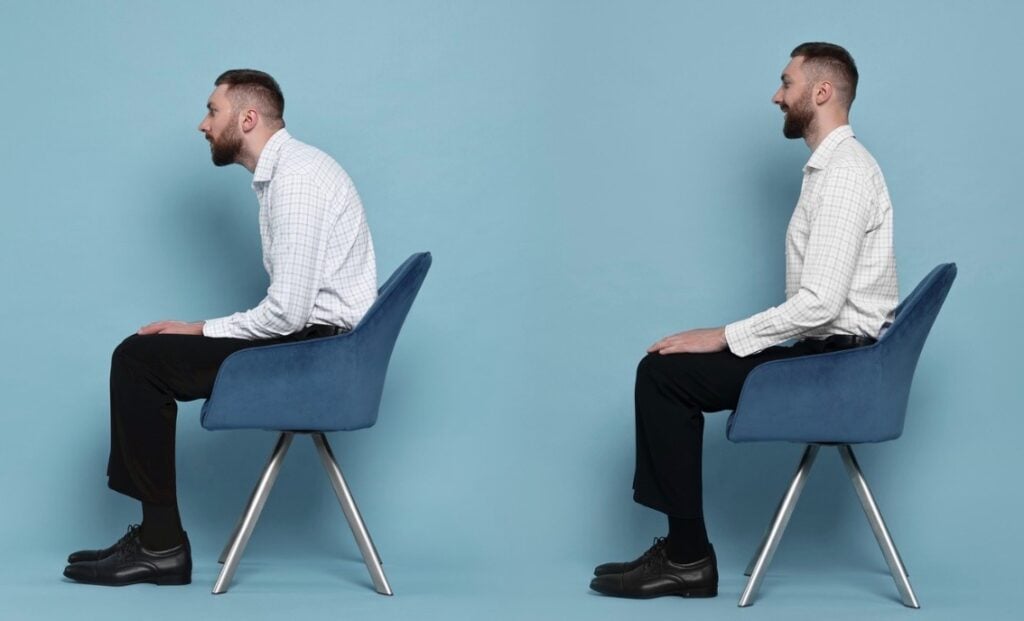
One of my virtual clients, an executive who sat most of the day, came to me struggling with sitting and back pain and stiffness. I built him a simple routine requiring movement every 30 minutes, each break taking under 45 seconds. That adds up to under 15 minutes of total movement across an eight-hour day. After two weeks, his lower back had decompressed to the point where he could sit comfortably again, and his pain at home with his family had dropped significantly. As a bonus, he also lost seven pounds simply from consistent movement.
Four Habits That Protect Your Spine at a Desk Job
- Sit with proper ergonomics: hips slightly higher than your knees, feet flat on the floor, chest lifted, and your screen at eye level.
- Move every 30 minutes. Set a timer. Even 60 seconds of standing, air squats, or posture work reactivates your stabilizing muscles.
- Consider a posture sensor that gently reminds you when you’ve been sitting poorly for too long.
- Try a posture shirt or elastic strap that encourages muscle engagement rather than a rigid brace that does the work for you.
Sitting itself isn’t the enemy. Sitting without movement or awareness is. The small habit of standing and moving every 30 minutes could be the difference between chronic pain and a strong, mobile spine for the rest of your life.
Your Next Step
If your job keeps you at a desk most of the day, this is one of the most important habits you can change. We built a complete system to help people like you reverse the damage of prolonged sitting for good.
Ready for a plan built around your schedule and your pain? Schedule a consultation and let’s map it out together.